The Curious Outsider Who Read What Scholars Couldn't: Cracking the Dead Sea Scrolls
A Discovery That Belonged to Everyone — Except Him
When Bedouin shepherds stumbled across clay jars in the caves of Qumran in 1947, they unknowingly handed the academic world one of its greatest puzzles. The Dead Sea Scrolls — nearly a thousand ancient texts spanning Hebrew, Aramaic, and a smattering of other ancient languages — became the exclusive territory of a small, fiercely protective circle of scholars. Access was restricted. Progress was slow. And for decades, some of the most contested fragments sat in interpretive limbo, their meanings argued over in hushed conference rooms and dense academic journals.
Into this locked room walked someone who had never been handed a key.
Norman Golb spent his early years far outside the gilded corridors of elite biblical scholarship. A voracious reader from childhood, he taught himself ancient languages the way some kids teach themselves guitar — obsessively, imperfectly, and without anyone telling him the "right" way to do it. He eventually found his footing at the University of Chicago's Oriental Institute, but his path there was anything but conventional, and his relationship with the dominant Dead Sea Scrolls establishment was, to put it charitably, adversarial.
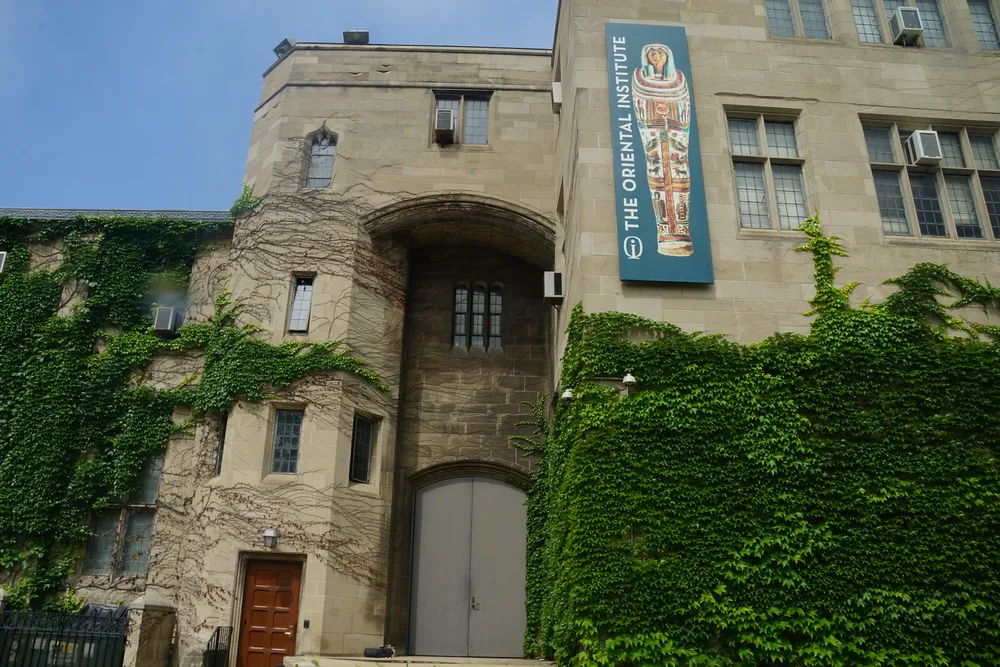 Photo: University of Chicago's Oriental Institute, via photos.smugmug.com
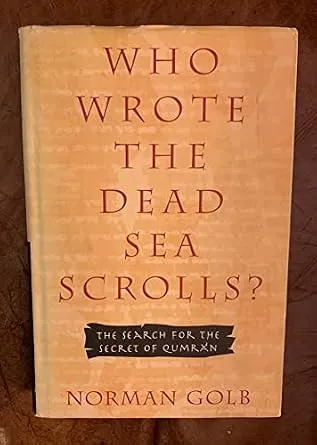 Photo: Norman Golb, via m.media-amazon.com
When the Consensus Becomes a Cage
By the time Golb entered the debate in earnest during the 1980s, a comfortable orthodoxy had settled over Dead Sea Scrolls scholarship. The prevailing theory — championed by the scholars who controlled access to the texts — held that the scrolls were produced by a single isolated Jewish sect called the Essenes, who lived at Qumran and composed the documents as a kind of spiritual library. It was a tidy narrative. It was also, Golb argued, almost certainly wrong.
What Golb saw, when he looked at the scrolls without the filter of institutional consensus, was diversity. The handwriting styles varied too wildly to come from one scribal community. The texts represented too many different and sometimes contradictory theological perspectives. The sheer volume of material was inconsistent with a small desert sect. His reading of the evidence pointed instead to Jerusalem — to a massive collection of texts from across Jewish society, hidden in the caves as Roman armies bore down on the city in 70 CE.
This was not a minor amendment to existing theory. It was a demolition of it.
The Price of Saying Something Different Out Loud
The response from the establishment was swift and largely unkind. Golb was dismissed, condescended to, and — in the way academic worlds have always dealt with uncomfortable outsiders — simply not invited to the table. The tight circle controlling access to the unpublished scrolls had little interest in entertaining a challenge from someone who hadn't come up through the right channels.
But Golb had an advantage that credentialed insiders rarely possess: he had nothing to protect. No theory of his own had been built into the existing consensus. No career had been constructed on top of the Essene hypothesis. He could look at the evidence freshly precisely because he hadn't spent thirty years defending a particular reading of it.
He also had an outsider's instinct for the political dimensions of scholarly gatekeeping. While the inner circle sat on unpublished fragments for decades — a situation that eventually became a public scandal — Golb was loudly, persistently demanding that the scrolls be made available to all researchers. He wasn't just arguing about ancient history. He was arguing about who gets to make history.
When the Walls Finally Came Down
The monopoly on scroll access collapsed in the early 1990s, when unauthorized photographs of unpublished fragments were released and the Huntington Library in California announced it would make its complete set of scroll photographs available to any qualified researcher. Suddenly, the texts belonged to everyone.
What followed was a gradual, grudging shift in the scholarly conversation. While no single theory has fully replaced the Essene hypothesis, Golb's core arguments — that the scrolls represent a diverse, Jerusalem-based collection rather than the product of a single sect — have gained significant traction among researchers who came to the texts without prior commitments to the old consensus. The debate is still alive, still heated, and still unresolved in places. But the certainty that once surrounded the Essene theory has dissolved.
Golb spent decades being told he was wrong by people who controlled the evidence he needed to prove he was right. That is not a comfortable position. It requires a particular kind of stubbornness — the kind that comes not from arrogance but from having looked at something carefully and trusted what you saw.
What the Scrolls Teach Us About Who Gets to Know
There's a version of this story that ends neatly, with vindication and a standing ovation. Real life is messier. Golb's relationship with the field remained complicated, and his later years brought personal and professional turbulence that complicated his legacy in ways that have nothing to do with ancient manuscripts.
But the intellectual core of what he did — walking into a locked room without a key and reading what was written on the wall — remains genuinely remarkable. He looked at texts that scholars had been staring at for decades and saw something different, not because he was smarter than everyone else, but because he hadn't been trained to see what he was supposed to see.
The Dead Sea Scrolls are, among other things, a story about preservation — about what survives when institutions crumble and empires fall. Golb's story is a smaller version of the same thing: a reminder that knowledge sometimes survives precisely because someone outside the institution refused to let it be buried.