Hidden in Plain Sight: Five Everyday Inventors Whose Simple Ideas Built Modern America
The Revolution You Never Noticed
Walk through your house right now. Look at your kitchen, your bathroom, your garage. Chances are, you're surrounded by innovations that started as desperate solutions in the minds of people who were never supposed to matter. People who worked with their hands, who solved problems because they had to, who filed patents that gathered dust for decades before changing the world.
These aren't the household names of American invention—no Edison, no Ford, no Jobs. These are the forgotten pioneers whose simple ideas became so fundamental to daily life that we can't imagine living without them.
Sarah Boone: The Laundress Who Perfected Your Morning Routine
Patent #473,563, Filed April 26, 1892
 Photo: Sarah Boone, via www.newsnationnow.com
Sarah Boone spent her days bent over other people's clothes, pressing wrinkles from garments she'd never be able to afford. As an African American woman in 1890s Connecticut, her options were limited—domestic work, laundry, maybe seamstressing if she was lucky.
But Sarah had a problem that drove her crazy: the ironing board. The flat wooden planks that everyone used made it nearly impossible to iron sleeves and fitted garments properly. You'd get one side smooth, then wrinkle the other side trying to maneuver around the board.
Working in her small apartment after long days at the commercial laundry, Sarah began experimenting. She created a narrow, curved board that could fit inside sleeves and around the contours of women's fitted bodices. The design was so obviously better that she wondered why nobody had thought of it before.
Her patent application was approved with barely any questions. The patent office recognized a good idea when they saw one, even if they didn't recognize the name attached to it.
Today, every ironing board in America uses Sarah Boone's basic design. The curved, narrow shape that makes it possible to iron a shirt properly? That was her innovation. The collapsible legs that let you store the board in a closet? Also hers.
Sarah died in 1904, probably never knowing that her simple solution would become standard equipment in every American household.
Granville Woods: The Railroad Man Who Wired the World
Patent #315,368, Filed April 7, 1885
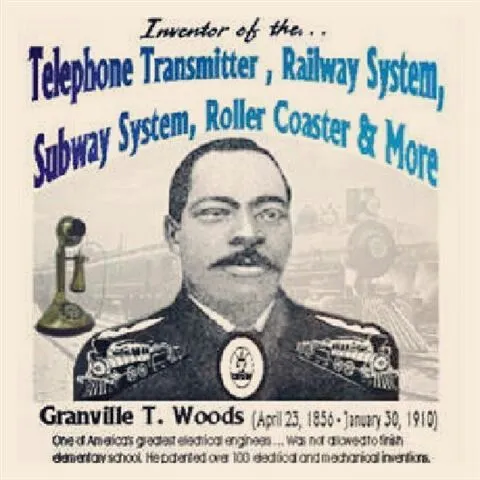 Photo: Granville Woods, via i.pinimg.com
Granville Woods was what they called a "car barn man"—a railroad mechanic who kept the trains running on time. He worked the night shift in Cincinnati, fixing brake systems and adjusting signals, invisible to the passengers who depended on his expertise.
But Granville had noticed something that kept him awake during the day: trains were constantly colliding because engineers couldn't communicate with each other or with the stations. The railroad system was growing faster than its ability to coordinate itself.
In his spare time, Granville began tinkering with telegraph technology, trying to figure out how to send messages to and from moving trains. The technical challenges were enormous—how do you maintain an electrical connection with something traveling sixty miles per hour?
His solution was brilliant in its simplicity: use the rails themselves as conductors, and create induction between stationary telegraph wires and equipment on the trains. Suddenly, engineers could communicate with stations and with each other, dramatically reducing accidents.
Granville's "induction telegraph system" became the foundation of modern train communication. But more than that, his principles of wireless electrical communication helped pave the way for radio, television, and eventually cell phones.
Thomas Edison tried to buy several of Granville's patents. When that didn't work, Edison hired him as a consultant. The railroad mechanic had become too valuable to ignore.
Mary Kies: The Teacher Who Solved New England's Hat Problem
Patent #X3637, Filed May 5, 1809
Mary Kies was a schoolteacher in Killingly, Connecticut, which meant she spent her summers looking for ways to make extra money. In 1809, that usually meant some form of handicraft—spinning, weaving, or sewing.
But Mary had noticed an opportunity that others missed. New England's hat industry was struggling because they couldn't get silk from Europe due to trade embargoes. Hat makers were desperate for alternatives, but straw alone was too flimsy, and fabric alone was too expensive.
Mary began experimenting with combining silk thread and straw in new ways, creating a weaving technique that produced material strong enough for hat-making but affordable enough for mass production. Her process used silk as reinforcement rather than the primary material, stretching expensive imports while maintaining quality.
When she received her patent—the first ever granted to an American woman—it caused a sensation. Here was a schoolteacher from rural Connecticut who had solved a problem that had stumped entire industries.
Mary's technique revitalized New England's hat industry and established the foundation for American textile manufacturing. Her innovation helped break American dependence on European luxury goods, proving that practical ingenuity could compete with established craftsmanship.
The hat industry that employed thousands of Americans for the next century? It started with a schoolteacher who needed summer income.
Garrett Morgan: The Mechanic Who Saved Lives by Accident
Patent #1,090,936, Filed March 20, 1914
Garrett Morgan ran a sewing machine repair shop in Cleveland, which meant he spent his days covered in oil and fabric fibers. Like most mechanics, he was always looking for better ways to clean and maintain equipment.
One day, while experimenting with a chemical solution to reduce friction on sewing machine needles, Garrett accidentally spilled some of the mixture on a cloth. When he wiped it up, he noticed something strange: the fibers in the cloth had straightened out.
Intrigued, Garrett began testing his solution on different materials. Hair straightened. Fur became smooth. What he'd stumbled upon was one of the first effective chemical hair relaxers.
But Garrett was an African American man in 1910s America, which meant he couldn't easily market beauty products under his own name. So he created a fictional white businessman named "G.A. Morgan" and built an entire company around this persona.
The hair relaxer made Garrett wealthy enough to pursue his real passion: safety equipment. He used the profits to develop the gas mask that would save thousands of lives in World War I, and later invented the traffic signal that still controls intersections today.
Garrett's accidental beauty product discovery funded innovations that made modern urban life possible. Sometimes the most important inventions start with the least important problems.
Chester Greenwood: The Teenager Who Warmed America's Ears
Patent #188,292, Filed December 21, 1877
Chester Greenwood was fifteen years old and tired of frozen ears. Growing up in Farmington, Maine, meant dealing with brutal winters, and Chester's ears were particularly sensitive to cold. Hats made his head too hot, scarves were clumsy, and nothing seemed to solve the specific problem of keeping ears warm without overheating everything else.
So Chester did what teenagers do: he improvised. He bent a piece of wire into loops that would fit over his ears, then asked his grandmother to sew fur padding onto the wire frames. The result was crude but effective—the world's first earmuffs.
Chester's friends laughed, but they stopped laughing when they saw how well his contraption worked. Soon, half the kids in Farmington wanted their own "ear protectors."
By the time Chester turned eighteen, he was manufacturing earmuffs commercially. His design was so practical that it remained essentially unchanged for decades. During World War II, American soldiers wore earmuffs based on Chester's original patent.
Chester eventually expanded into other cold-weather gear, but earmuffs remained his signature product. The Greenwood Company employed hundreds of workers in rural Maine, proving that even the smallest innovations could build entire industries.
The teenager who just wanted warm ears had created a product category that didn't exist before he invented it.
The Pattern Behind the Patents
These five inventors shared something more important than creativity: they shared proximity to real problems. They weren't trying to imagine what people might want—they were solving problems they faced every day.
Sarah Boone knew exactly how frustrating it was to iron sleeves because she ironed thousands of them. Granville Woods understood train communication failures because he fixed the equipment when things went wrong. Mary Kies saw the hat industry's struggles because she lived in the middle of it.
Their innovations succeeded because they emerged from genuine need, not market research. They worked because they solved problems that millions of people didn't even realize they had.
Today, we celebrate the flashy breakthroughs—the smartphones and electric cars and social media platforms. But the foundation of daily life still rests on the simple solutions discovered by people who were just trying to make their own lives a little bit easier.
The next time you iron a shirt, board a train, wear a hat, style your hair, or warm your ears, remember: you're using technology invented by people who were supposed to stay invisible. Their names might be forgotten, but their ideas became America.