The Troublemaker Who Drew the Mind: How a Spanish Rebel Sketched the Blueprint of Human Thought
The Boy Who Couldn't Sit Still
In 1860s Spain, if you were the son of a village barber-surgeon and couldn't stop getting into trouble, your future looked pretty bleak. Santiago Ramón y Cajal seemed destined for a life of manual labor—assuming he could stay out of jail long enough to hold down a job.
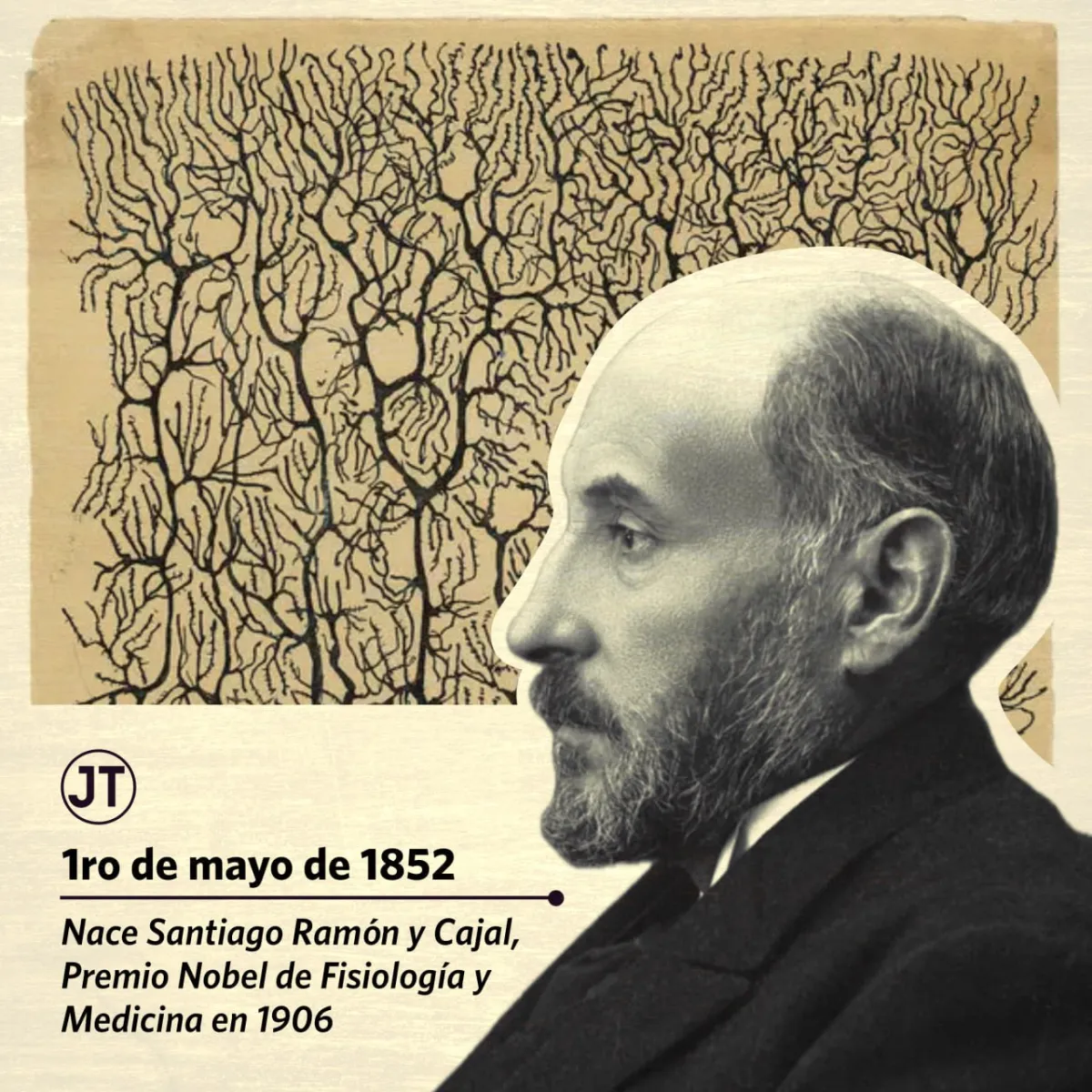 Photo: Santiago Ramón y Cajal, via www.juventudtecnica.cu
By age eleven, he'd already been imprisoned for destroying his neighbor's gate with a homemade cannon. His teachers called him "impossible." His father, Justo, despaired of ever making anything respectable out of his wild son. The boy couldn't focus on his studies, preferred drawing to reading, and had an unsettling habit of asking questions nobody wanted to answer.
What nobody realized was that Santiago's restless mind was already working exactly the way it needed to—with the kind of obsessive curiosity that would eventually redraw humanity's understanding of itself.
Learning from the Dead
When Santiago turned sixteen, his exasperated father made a last-ditch attempt to straighten him out. If the boy wouldn't study books, maybe he'd at least learn a trade. Justo dragged his son to the local cemetery and announced they were going to study anatomy—the old-fashioned way.
Father and son began digging up bodies under cover of darkness, a common practice for medical education in an era when formal cadavers were nearly impossible to obtain. But while his father saw this as vocational training, Santiago saw something else entirely: the most beautiful, complex puzzle he'd ever encountered.
Night after night, by candlelight in their makeshift laboratory, Santiago began sketching what he saw. His artistic training—dismissed by everyone as a waste of time—suddenly became his greatest asset. He could see patterns in tissue that others missed, relationships between structures that had never been properly documented.
The Dropout's University
Santiago did eventually make it to medical school, but barely. He failed his first anatomy exam, struggled with Latin, and found most of his professors boring. What kept him going wasn't the formal curriculum—it was his private obsession with understanding how the body actually worked.
While his classmates memorized textbook diagrams, Santiago was creating his own. He spent every spare moment hunched over a microscope, sketching neurons and nerve fibers with an accuracy that his professors found almost unnerving. Here was a student who seemed to care more about dead tissue than living patients.
After graduating near the bottom of his class, Santiago was shipped off to Cuba as a military doctor—essentially exile for someone the medical establishment didn't quite know what to do with. He returned to Spain wracked with malaria and more convinced than ever that the real secrets of medicine lay in places no one was looking.
Drawing What Others Couldn't See
Back in Spain, Santiago took a position at a small university in Valencia—hardly a prestigious appointment, but it gave him access to a laboratory and, more importantly, the freedom to pursue his strange passion for neural anatomy.
This was the 1880s, and the structure of the nervous system was one of the great unsolved mysteries of science. Most researchers believed that nerve cells were connected in one continuous network—like a fishnet made of living tissue. Santiago suspected something entirely different.
Working alone, often late into the night, he began developing new staining techniques that would make individual neurons visible under the microscope. What he saw changed everything: neurons weren't connected in a continuous web. They were individual cells that communicated across tiny gaps—synapses.
The Illustrations That Rewrote Medicine
Santiago's breakthrough wasn't just scientific—it was artistic. His hand-drawn illustrations of neurons were so detailed, so accurate, that they looked more like technical blueprints than biological sketches. He drew nerve cells with the precision of an architect and the eye of a poet.
These drawings became the foundation of what we now call the "neuron doctrine"—the understanding that the nervous system is made up of individual cells rather than a continuous network. It was a revolutionary idea, and Santiago had the visual proof to back it up.
By the 1890s, his work was attracting international attention. Scientists who had initially dismissed the Spanish provincial as an amateur were forced to confront the evidence of his extraordinary illustrations. Here was a man who had literally drawn the blueprint of human consciousness.
Recognition and Revolution
In 1906, Santiago Ramón y Cajal won the Nobel Prize in Physiology or Medicine—the first Spanish scientist ever to receive the honor. The citation praised his work on "the structure of the nervous system," but that barely captured the magnitude of his achievement.
This was a man who had started as a troublemaker in a tiny Spanish village, who had learned anatomy by robbing graves, who had been written off by the academic establishment. Yet his hand-drawn maps of the brain became the foundation of modern neuroscience.
Today, more than a century later, Santiago's illustrations still appear in medical textbooks. His techniques for visualizing neurons are still used in laboratories around the world. The "neuron doctrine" he established remains one of the fundamental principles of brain science.
The Outsider's Advantage
Santiago Ramón y Cajal's story reveals something profound about how breakthrough discoveries actually happen. Sometimes the biggest advantages come from having no advantages at all.
Because he learned anatomy outside the formal system, Santiago wasn't constrained by existing theories about how neurons were supposed to work. Because he was isolated from the scientific establishment, he was free to follow his observations wherever they led. Because he had to teach himself everything, he developed an unusually direct relationship with the evidence.
Most importantly, because he approached science as an artist as much as a researcher, he could see patterns that purely analytical minds might miss. His drawings weren't just illustrations—they were discoveries.
The boy who couldn't sit still in school had found the one thing that could hold his attention forever: the infinite complexity of the human brain. And in mapping that complexity, he gave the rest of us a new way to understand ourselves.