When Nobody Was Watching, She Connected Every Library on Earth
The Basement That Changed Everything
In 1965, while America was fixated on the space race and civil rights, something equally revolutionary was happening in a cramped basement office at the Library of Congress. A 42-year-old librarian named Henriette Avram was hunched over stacks of catalog cards, trying to solve what seemed like the most boring problem in the world: how to make library records machine-readable.
Nobody was paying attention. Nobody understood what she was building. And that's exactly how Henriette Avram managed to create the invisible backbone of the modern internet.
The Accidental Revolutionary
Avram didn't set out to revolutionize anything. Born to Russian Jewish immigrants in New York, she had studied mathematics at Hunter College before World War II interrupted everything. Like so many women of her generation, she put her career on hold to raise a family. When she finally returned to work in her forties, the Library of Congress seemed like a safe, quiet place to restart.
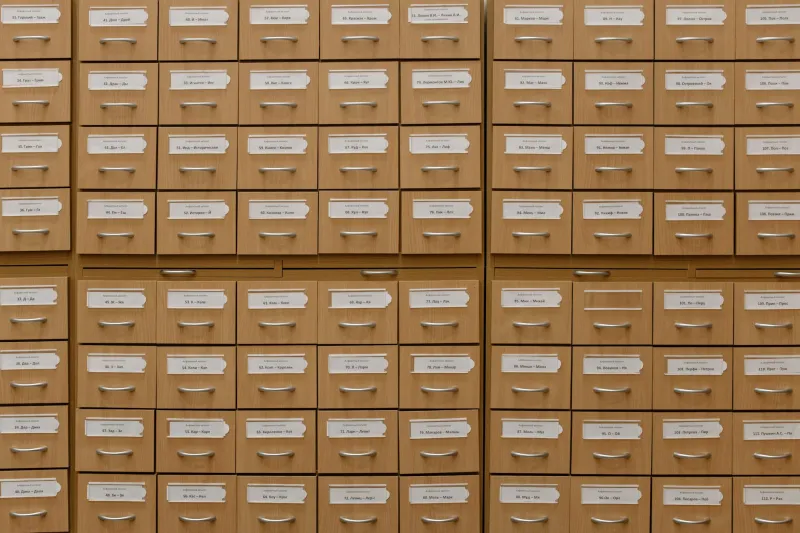
But Avram walked into an institution in crisis. The Library of Congress was drowning in its own success, adding 15,000 new items every working day. The traditional card catalog system—those wooden drawers filled with typed index cards that every library relied on—was breaking down under the sheer volume. Something had to change.
The Language That Speaks to Machines
What Avram created was called MARC—Machine Readable Cataloging. The name sounds technical and boring, which is probably why most people have never heard of it. But MARC was actually something much more profound: the first universal language that allowed computers to understand and organize human knowledge.
Think of it this way: before MARC, every library was like an isolated island. A book cataloged in New York couldn't be easily understood by a computer in California. Libraries couldn't share information efficiently. Researchers had to physically travel to different institutions to find what they needed.
Avram changed all that by creating a standardized format—a kind of digital DNA for every book, article, and document. Each MARC record contained not just basic information like title and author, but structured data that computers could read, sort, and share across any distance.
Fighting the Resistance
The library world wasn't exactly thrilled with Avram's innovation. Many librarians saw computers as a threat to their expertise. Publishers worried about losing control over their catalogs. Even within the Library of Congress, colleagues questioned whether this soft-spoken woman really understood what libraries needed.
Avram faced the same skepticism that greets most quiet revolutionaries. She wasn't a charismatic leader or a smooth-talking entrepreneur. She was just a methodical problem-solver who happened to see connections that others missed. While her critics focused on preserving the old ways, Avram was quietly building the future.
The Ripple Effect Nobody Saw Coming
By 1968, MARC was being used by libraries across America. By the 1970s, it had spread worldwide. But even Avram probably couldn't have predicted what would happen next.
The principles she embedded in MARC—standardized metadata, structured information, universal accessibility—became the foundation for how all digital information is organized. When Tim Berners-Lee created the World Wide Web, he built on concepts that Avram had pioneered. When Google developed its search algorithms, they relied on the same kind of structured data relationships that MARC had established.
Every time you search Amazon for a book, check Wikipedia for information, or use any online database, you're benefiting from the framework that Henriette Avram created in that Library of Congress basement.
The Invisible Infrastructure
Today, MARC records are everywhere and nowhere. They're the invisible plumbing of the information age—absolutely essential, but completely hidden from view. Your local library still uses MARC. So does the British Library, the Bibliothèque Nationale de France, and virtually every major research institution on Earth.
But Avram never became a household name like Steve Jobs or Bill Gates. She never gave TED talks or appeared on magazine covers. She just kept working, refining her system, and watching it spread across the world without fanfare.
The Legacy of Quiet Innovation
Henriette Avram retired in 1992, having spent nearly three decades perfecting the system that made global information sharing possible. She died in 2006, just as the internet was exploding into the dominant force she had helped create.
Her story challenges our assumptions about innovation. We tend to celebrate the flashy entrepreneurs and dramatic breakthroughs, but some of the most important advances come from people working quietly in the background, solving problems that seem mundane but turn out to be transformative.
Avram proved that you don't need a computer science degree from Stanford or venture capital funding to change the world. Sometimes all you need is the patience to see a better way forward and the persistence to build it, one catalog record at a time.
In an age of digital disruption and startup unicorns, Henriette Avram's triumph reminds us that the most lasting revolutions often happen when nobody's watching—in basement offices, by quiet innovators who care more about solving problems than getting credit for the solutions.