Iron in the Blood: The Night-School Welder Who Kept America's Bridges Standing
The photograph from the opening ceremony shows a familiar scene: men in overcoats and hats, a ribbon, a pair of ceremonial scissors, a mayor grinning at the cameras. The bridge behind them is a cathedral of steel, arching over the water like it had always been there.
The man who actually figured out how to build it isn't in the photo.
He was in the site office, still wearing his work coat, reviewing the notes from the night shift. His name, when it appears at all in the newspapers of the era, appears in the fine print — 'consulting engineer,' 'of the construction firm.' But the men on the crew knew the truth. When the plans stopped making sense, when the steel wouldn't behave, when the river did something the textbooks said rivers didn't do, they didn't call the architect. They called him.
Learning Steel the Hard Way
He arrived in the trade the way most working men did in the early twentieth century: through a relative, at fourteen, carrying tools he didn't yet know how to use. There was no engineering degree waiting. His family needed wages, not diplomas. So he worked days on the iron — riveting, fitting, welding in the days before welding was respected — and went to night school three evenings a week to learn the mathematics that the men in the drafting room took for granted.
It took him nearly a decade to finish the coursework that a university student covered in four. But there was a difference. The university student learned load calculations from a blackboard. He learned them from a beam that hummed under his feet, from a connection that had failed, from a foreman who pointed at a joint and said, 'That's where she'll break, son. Watch.'
He was almost always right.
The Problem-Solver of Last Resort
The construction boom that reshaped America between the 1910s and the 1950s ran on a strange division of labor. Famous designers produced drawings of breathtaking ambition — longer spans, taller frames, thinner steel. Then someone had to make those drawings obey the laws of physics, on budget, in weather, with a workforce that spoke four languages.
That someone was usually a man like him.
On one span across a fast, moody river, the caissons — the giant inverted boxes sunk to the riverbed so crews could dig the foundations — kept running into trouble. The official plans assumed a riverbed that turned out to exist mostly on paper. Work stalled for weeks. The project's investors were panicking, and the designer, hundreds of miles away in his office, sent memos instead of answers.
The night-school engineer spent two weeks living on the site barge. He interviewed the old sandhogs — the men who dug the footings — because he'd been one of them and they trusted him. Their descriptions of the riverbed, combined with his hard-won mathematics, produced a revised foundation plan that the celebrated firms had missed. The bridge opened on schedule. The memos from headquarters praised 'the construction team.'
He kept a file of such episodes. By the end of his career it held three decades of them: the skyscraper frame that needed a hidden solution for wind sway, the tunnel that had to dodge a subway line nobody had mapped, the wartime bridge built in months when years were expected.
The Hands That Built the Skyline
Here's the thing about America's vertical century: it was built twice. Once on paper, by men with famous names and famous schools. And once in steel and sweat, by graduates of night school, trade apprenticeships, and the immigrant neighborhoods of Pittsburgh, Chicago, and the Iron Range — men who could read a blueprint and a thundercloud with equal fluency.
Engineers like him were not rare, exactly. But they were rarely credited. Their expertise lived in the industry's muscle memory, passed from crew to crew, never quite making it into the textbooks or the dedication plaques. When one of them died, an obituary might mention that he 'was associated with many notable projects.' Associated. As if the bridge were a party he'd attended.
Why His Story Matters Now
We talk a lot today about who gets to be an engineer, and we should. But there's a quieter lesson in his life that cuts the other way: the country's most celebrated structures depended on knowledge that no credential could certify. Judgment. Craft. The willingness to stand on the steel and feel what the drawing couldn't tell you.
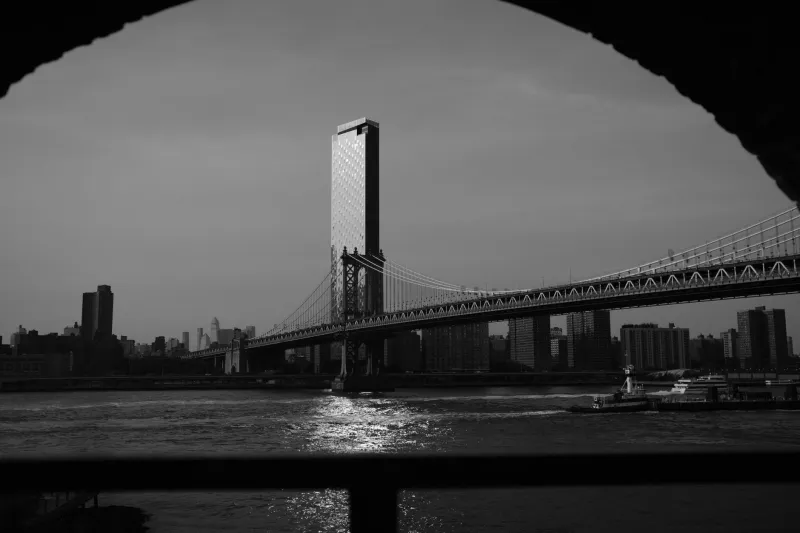
The next time you cross one of the great old spans — the bridges of New York, the towers of Chicago, the tunnels under the Hudson — remember the man in the site office with his work coat and his hand-ruled calculations. The ribbon was for the men with scissors. The bridge was for the men like him.
And the door he walked through — night school, no connections, hands first, credentials later — is one America should never stop prying open.